

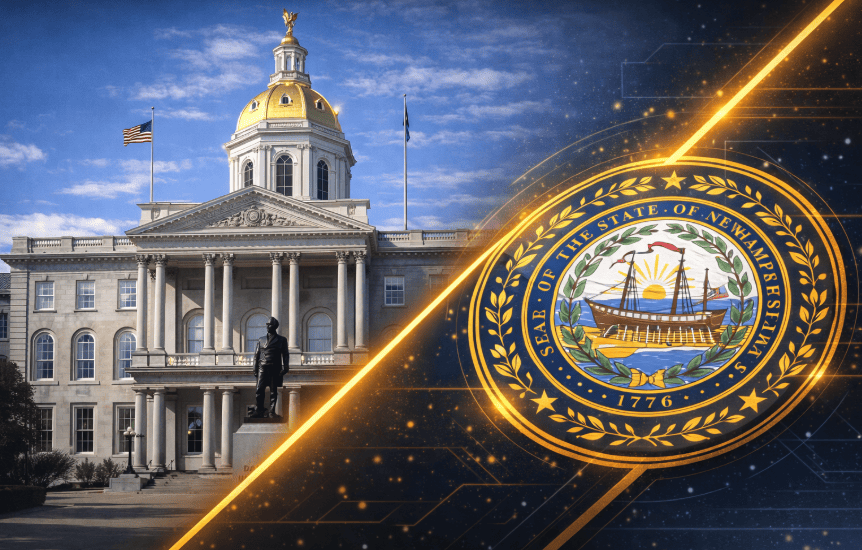
New Hampshire officially passed the Strategic Bitcoin Reserve Act, marking the beginning of the era of crypto asset reserves at the U.S. state level.
On May 6, 2025, the State of New Hampshire officially became the first U.S. state to pass legislation authorizing the establishment of a Strategic Bitcoin Reserve and digital asset investment framework.
Governor Kelly Ayotte signed House Bill 302 (HB 302) into law, marking a historic milestone in U.S. state-level digital asset policy.
This legislation authorizes the state to hold and invest in Bitcoin and other digital assets as part of its strategic financial reserves, signaling a major shift in how state governments approach crypto assets.
The passage of HB 302 positions New Hampshire at the forefront of digital asset adoption among U.S. states.
What Is HB 302?
House Bill 302 (HB 302) grants New Hampshire the legal authority to:
Establish a Strategic Bitcoin Reserve
Allocate state funds into Bitcoin and approved digital assets
Hold digital assets as part of the state’s long-term financial strategy
Develop a regulatory framework for digital asset custody and investment
This makes New Hampshire the first U.S. state to formally legislate a strategic digital asset reserve framework.
Why This Is Significant
This is not a symbolic move. It represents a structural policy shift at the state level.
Until now, digital asset discussions in U.S. state governments were largely limited to:
Regulation
Taxation
Licensing
Consumer protection
HB 302 goes a step further:
It moves crypto from regulation into state treasury strategy.
This places digital assets directly within the state’s financial architecture.
State-Level Bitcoin Reserves: A New Trend Begins
With New Hampshire leading, this law sets a precedent for other U.S. states.
Many states are now actively exploring:
Digital asset investment bills
Crypto reserve proposals
Blockchain treasury frameworks
New Hampshire’s move sends a clear signal:
State governments are no longer just supervising crypto. They are beginning to hold it.
This accelerates the normalization of Bitcoin as a public-sector asset.
How This Connects to the Federal Announcement
The passage of HB 302 comes just weeks after the U.S. federal government announced the establishment of the U.S. Strategic Bitcoin Reserve and U.S. Digital Asset Stockpile via Executive Order.
Together, these developments show:
Federal recognition of Bitcoin as a strategic asset
State-level legislative action to operationalize digital asset reserves
This is not a coincidence. It reflects a coordinated shift in policy direction across levels of government.
Implications for the Crypto Industry
From an industry perspective, this is a major development:
• Institutional Legitimacy Expands
When both federal and state governments begin holding Bitcoin, it dramatically increases institutional legitimacy.
• Regulatory Clarity Improves
Governments that hold assets are incentivized to:
Define clearer rules
Improve custody standards
Strengthen compliance frameworks
• Long-Term Market Confidence Strengthens
Public-sector participation supports the narrative of Bitcoin as:
a long-term financial asset, not a speculative experiment
What This Means for Users and Platforms
For users:
Crypto is increasingly embedded in public financial systems
Legitimacy and stability narratives are strengthening
Regulatory recognition continues to expand
For compliant platforms:
The industry is shifting toward regulated, transparent, and accountable operations
Platforms with strong compliance positioning are structurally advantaged
A Turning Point at the State Level
New Hampshire’s passage of HB 302 marks a turning point.
Bitcoin is no longer only:
debated in hearings
regulated by agencies
traded by individuals
It is now:
written into state law as a strategic financial asset.
This reflects a deeper reality:
Digital assets are moving from the market into government balance sheets.
Conclusion
By signing HB 302 into law on May 6, 2025, New Hampshire has become the first U.S. state to formally establish a legal framework for a Strategic Bitcoin Reserve.
This is not an isolated event. It is part of a broader transformation in how governments view digital assets.
From federal executive orders to state legislation, one message is becoming clear:
Bitcoin is entering the core of public financial strategy.